Brighton and Slavery’s Legacy
The money behind the town
Brighton, slavery and the people who lived here.
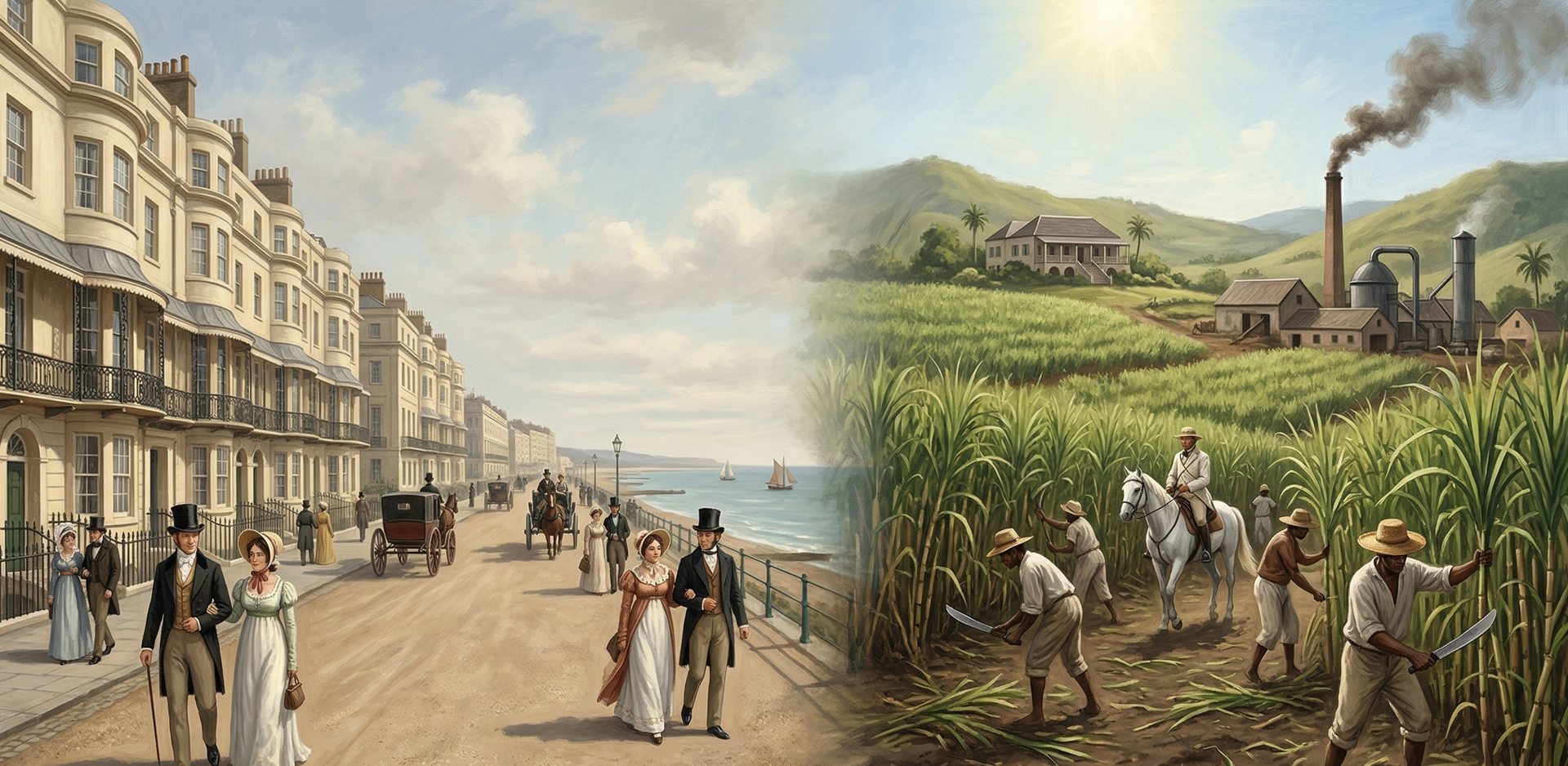
Brighton is often described as a place set slightly apart. A town shaped by the sea, by visitors, and by the promise of escape. But like many places in Britain, its past is tied into a much wider story. One that stretches far beyond the coastline.
Records from the UCL Legacies of British Slavery database show that at least 67 people with connections to Brighton and the surrounding area appear in claims linked to slavery. Some owned estates. Others held financial interests or inherited wealth tied to plantations. A number can be placed directly in the town through their addresses.
These links do not sit in distant archives alone. They reach into the streets themselves.
From plantation to Brighton
The estates connected to these individuals were spread across the Caribbean and beyond. Jamaica, Antigua, Barbados, British Guiana and Grenada all appear in the records.
Many of these were large plantations, where hundreds of enslaved people were recorded under a single claim. When slavery was abolished in the 1830s, the British government introduced compensation payments. These payments were made not to the people who had been enslaved, but to those who claimed ownership or financial interest.
Some of the largest sums recorded run into tens of thousands of pounds. Money of that scale did not remain where it was made. It moved, through families, investments and property, into towns like Brighton.
Five addresses, one story
What brings this history closer is the presence of named Brighton addresses in the records. These are places that still exist, still lived in, still passed every day.
At Hampden House on Marine Parade, a seafront address with open views across the Channel, Alexander Purcell Anderson is recorded in connection with the wider network of individuals linked to slavery claims.
Further inland, at Montpelier Road, Anna Rebecca Anderson appears in the records through a Brighton address, part of a family with direct links to compensation claims in the Virgin Islands.
Nearby, St Peter’s Place connects to several individuals, including John Matthews Boswell junior and Sarah Coppard. Their presence here reflects how these connections often ran through families and shared property.
In Hove, Brunswick Square, a grand address facing the sea, is linked to Sir Ralph Darling. His name appears in the records, placing him within the same broader system.
And at Clarendon Terrace, Letitia Taylor (née Nembhard) is recorded at a Brighton address, her name linking the town to Caribbean histories that are not immediately visible in the street itself.
A network, not a single story
Not every person connected to Brighton was a plantation owner in the same way. Some received compensation directly. Others appear as beneficiaries, trustees or mortgage holders. Some are present only through an address.
But taken together, they show something wider.
Slavery was not only a system of labour on distant estates. It was also a system of finance, inheritance and property. Wealth moved through it, and that wealth shaped lives and places far from the plantations themselves.
Brighton, as a growing town in the nineteenth century, became one of those places.
Reading the streets differently
Today, these addresses are part of everyday life. Marine Parade, Montpelier Road, Brunswick Square and Clarendon Terrace are familiar names, tied to the image of Brighton as a place of light and space.
Nothing in their appearance tells this story directly.
But the records sit alongside them, offering another way of seeing the same streets. Not as separate from the wider history of Britain, but as part of it.
Why this matters
For a long time, these connections have been easy to overlook. They are not marked on buildings or widely known.
Bringing them together does not change the physical city. But it changes how we understand it.
It shows that Brighton and Hove was not removed from the history of slavery. It was connected through people, through money, and through the quiet movement of wealth from plantation to town.
Recognising that connection is not about reducing the city to a single past. It is about seeing it more fully, and understanding the layers that sit beneath the places we know.
Notes on the research
- Names and addresses are drawn from the UCL Legacies of British Slavery database
- Individuals appear in a range of roles, including owners, claimants, beneficiaries and associated parties
- Compensation payments were made to slaveholders and related claimants after abolition, not to the enslaved
Related Articles
Related Articles